Kafka’s drawings: what survived, what was rescued, and why it matters
Franz Kafka is remembered as a writer—The Trial, The Castle, the short stories that made his name shorthand for a particular kind of modern dread. But there is another Kafka, less discussed and only recently visible at scale: Kafka the draftsman.
That this Kafka exists for us at all is, again, an accident of preservation—an accident with ethical friction built into it. The same friend who ensured Kafka’s literary afterlife, Max Brod, also rescued his drawings, often against Kafka’s explicit wishes. Manuscripts, letters, diaries, sketches: Brod kept what Kafka wanted burned.
And if the story of Kafka’s writing is inseparable from the question of betrayal-as-custodianship, the story of his drawings makes that tension sharper. Because the drawings weren’t merely incidental. Kafka sometimes turned to them as a primary tool of expression, even when words were his métier.
The student who drew before he published
Kafka’s most intensive period of drawing clustered around his student years in Prague—roughly 1901 to 1906—when he was studying at the German University, taking drawing lessons, attending art history lectures, and trying to connect with the city’s artistic circles. These weren’t casual doodles done in passing. He worked with “serious intent,” practiced, trained, and sought community.
Yet Kafka himself did not treat these images as works worth saving. He appears to have been indifferent at best, hostile at worst, toward the idea that his drawings deserved preservation.
Brod, by contrast, saw value immediately. Around the same period, he harbored artistic ambitions of his own—trying his hand at drawing, supporting contemporary artists, selectively collecting works. Kafka’s sketches appealed to him not only as artifacts of a friend, but as objects that belonged to the wider ecology of modern graphic expression.
So Brod began collecting them early—sometimes literally rescuing them from destruction.
“Anything I didn’t rescue was destroyed”
In the appendix to his 1948 book Franz Kafkas Glauben und Lehre (Franz Kafka’s Faith and Teaching), Brod describes the relationship bluntly:
Kafka, he says, was “more hostile to his drawings than to his literary production.” Anything Brod didn’t intervene to save would be lost. He would persuade Kafka to hand over his “scribblings,” pull them from the wastebasket, and even cut them out from the margins of Kafka’s law course notes—illegally reproduced transcripts, printed and circulated, then decorated with Kafka’s marginal figures.
It’s a startling image: Kafka producing sketches as part of the texture of study and daily life; Brod acting as scavenger, archivist, and future executor, literally trimming the edges of paperwork to extract what Kafka would have thrown away.
This is where the drawings become more than a biographical footnote. They aren’t merely “works Kafka happened to make.” They are works that survived because another person decided—again and again—that Kafka was wrong about the value of his own output.
Kafka’s will: “drawings” named, and sentenced
The common simplification is that Kafka wanted his writing destroyed. The fuller truth is more comprehensive—and more explicit.
In his 1921 will and testament, Kafka doesn’t only mention “writings,” but “drawings” too, asking Brod to burn diaries, manuscripts, letters, drawings—everything—without reading. The instruction is unambiguous: destruction as the final act of control over the archive.
Kafka could likely predict Brod’s refusal. He knew his friend well. But he asked anyway.
Brod refused anyway.
And as with the manuscripts, he refused “with good reason,” if you accept the argument that cultural inheritance can override private intention—especially when the work is already entangled in social meaning, influence, and public value.
The drawings survive inside that same moral question: not only what Kafka made, but who gets to decide whether it exists.
A love letter where drawing outruns language
If you want a single moment that flips the hierarchy—Kafka the writer reaching for drawing as the more precise instrument—it appears in a letter to his fiancée, Felice Bauer, dated February 11–12, 1913.
Kafka describes a dream in which they walk together through Prague’s Old Town Square, “closer… than when walking arm in arm,” but he can’t find language for the invented closeness. He tries twice, hits the same wall, and then pivots:
I’ll draw it.
He sketches the conventional arm-in-arm posture, then sketches their dream-walk—an invented mechanism for intimacy, closeness without attention. It’s not a decorative aside. It’s a problem-solving move: drawing as a way to transmit an image when words fail.
Then comes the even more revealing turn: he reflects on his earlier drawings with an intensity that appears almost nowhere else in his writing.
He tells Felice he “was once a great draftsman,” that academic lessons with a “bad woman painter” ruined his talent, and that his old drawings would give her something to laugh at. But the punchline carries emotional weight:
Those drawings, he says, “gave me greater satisfaction… than anything else.”
That is not the language of a casual hobby. It’s the language of a practice that once mattered at the level of identity—something that delivered a kind of direct satisfaction that writing, at least then, did not.
What the drawings are like: minimal, dynamic, strangely alive
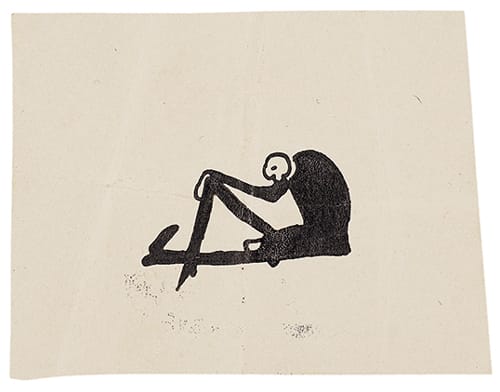
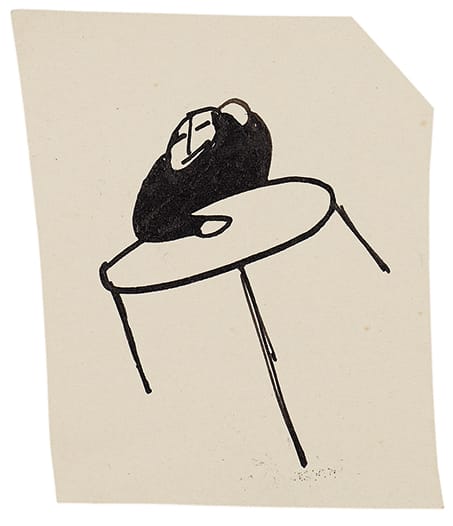
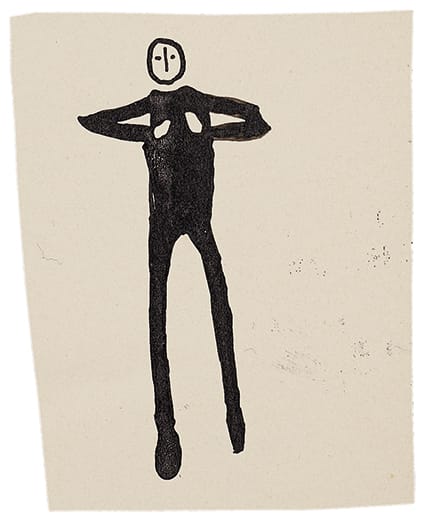
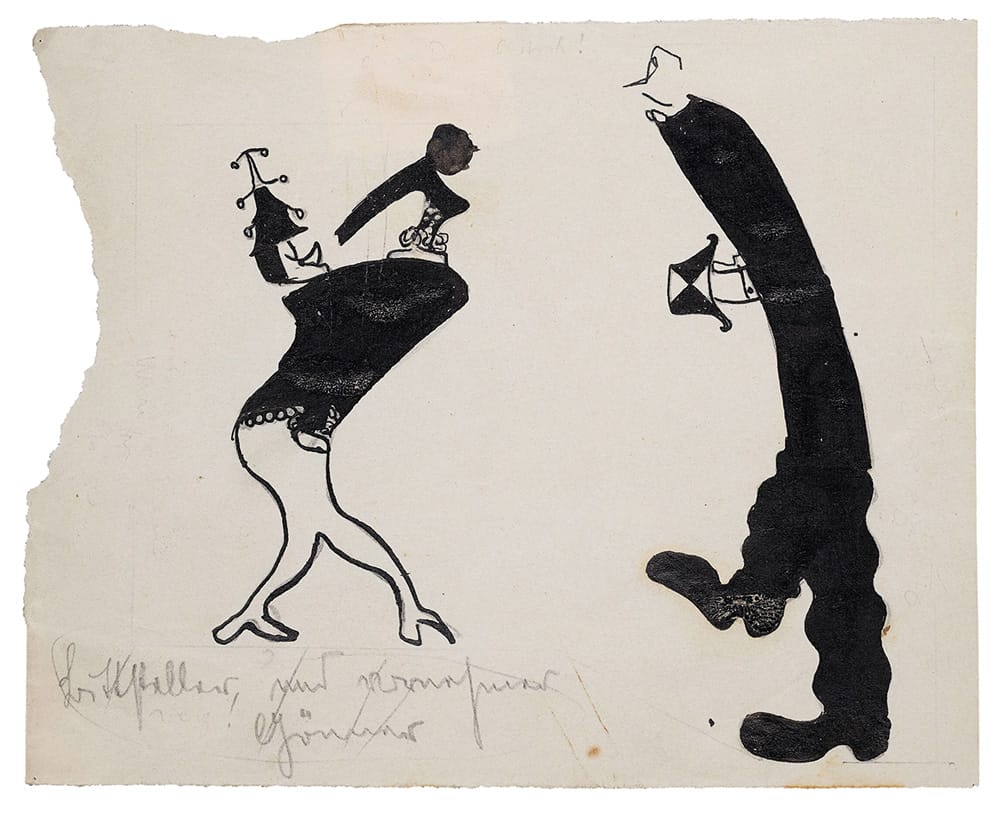
What survives from Kafka’s early drawing years—roughly 150 sketches—has its own visual logic.
They often suggest faces and figures with only a few strokes. Many are in profile, frequently leaning or moving, as if caught mid-motion. Recurring motifs include fencers, horseback riders, dancers—bodies in action. Sometimes the images shift into groups that stage “social intercourse”: human proximity, choreography, and tension.
Aesthetically, they tend toward the free-floating and the provisional: little surrounding context, flatness rather than depth, disproportion, fragility. They can feel caricatured, grotesque, carnivalesque—figures reduced to symbolic gestures, yet oddly expressive.
It would be easy to dismiss them as mere drafts. But one of the more interesting frames is the one Kafka himself absorbed from early twentieth-century modernist thinking about drawing: the idea that the sketch is not merely preparatory work for painting, but an art form with its own autonomy—an immediate statement, not a rehearsal.
The drawings are not “enigmatic hieroglyphs.” They read more like the record of a hand allowed to move without institutional constraint.
Doodling, attention, and “influx & efflux”
A contemporary essayist describing their own compulsive doodling—during Dungeons & Dragons, while on hold with customer service, through endless Zoom meetings—offers a useful bridge into Kafka’s sketches: doodling as a zone where mindlessness and mindfulness blur.
That tension is sharpened through a Zen-inflected lens (the present moment versus daydreaming), and then reframed again through political theorist Jane Bennett’s influx & efflux, a book prompted by years of doodling “in meetings, on the phone, while trying to read.” Bennett treats the doodle less as distraction and more as a porous practice: absorbing influence and returning it, like the sea shaping the shore and being shaped in return.
That metaphor is unusually fitting for Kafka.
Many of Kafka’s drawings literally emerge in margins—letters, notebooks, diaries—adjacent to thought rather than separate from it. They are the byproduct of attention being distributed across tasks, images bubbling up alongside language. Not the opposite of thinking, but one of thinking’s side-channels.
And that may be why the drawings are so resonant: they show Kafka not as the sealed, monumental “author,” but as an embodied person moving a pencil while living—responding to conversations, relationships, boredom, desire, social pressure, and private drift.
The quiet conclusion: Brod saved more than literature
Taken together, Kafka’s drawings complicate the familiar myth.
They show an artist who once felt drawing gave him “greater satisfaction… than anything else,” yet later dismissed or destroyed that work. They show a writer who sometimes reached for an image first, when language reached its limit. And they show how much of what we call “Kafka” is, in practice, mediated by Brod’s custodianship—his decision to preserve, organize, and defend an archive the author wanted erased.
In the end, the drawings don’t “explain” Kafka, and they don’t need to. They do something better: they expand the space in which Kafka can be seen—less as a fixed monument of modern literature, more as a maker whose imagination moved between sentence and line, between writing and the quick, fragile confidence of the sketch.
You can read more on Kafka on The Literary Hub